
How Many Portable Toilets Does a Construction Site Need?
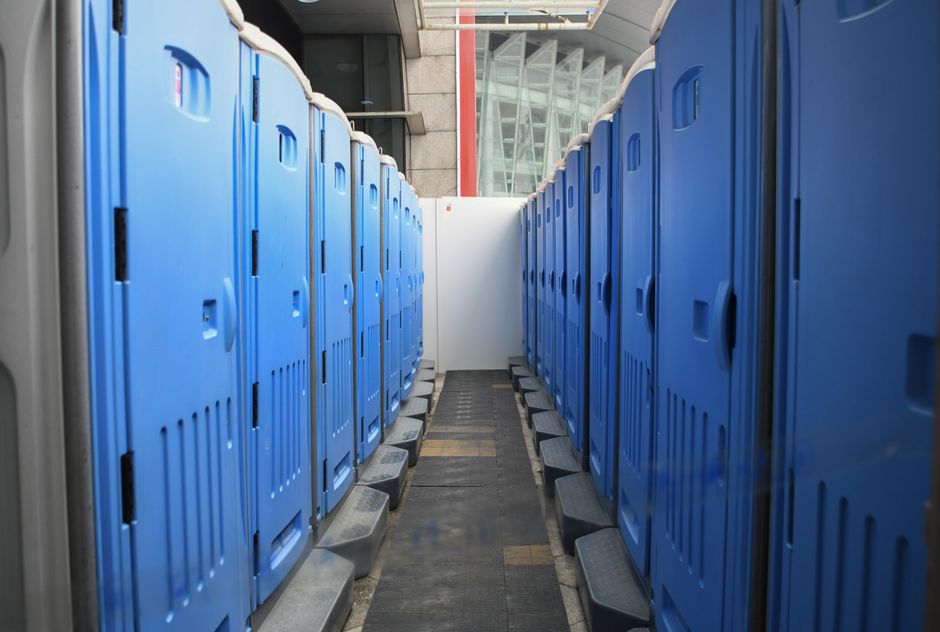
Plan portable toilets around the largest crew on site at one time, then place sanitary units where workers can reach them promptly. OSHA requires one toilet facility for 20 or fewer workers, one toilet seat and urinal per 40 workers for crews of 20 or more, and one seat and urinal per 50 workers at 200 or more. Service must keep every unit usable.
The count is the floor. Access and cleanliness decide whether the floor holds.
How many portable toilets are required for a construction crew?
Use peak headcount, then apply OSHA Table D-1. Average attendance is a poor planning number when crews overlap, deliveries arrive, or a short phase brings more trades onto the site.
OSHA's construction sanitation standard sets the minimum facility count. A portable unit can meet the need at a jobsite without a sanitary sewer when local codes allow chemical, recirculating, combustion, or other permitted toilet types.
| Peak crew on site | OSHA Table D-1 minimum | Planning reading |
|---|---|---|
| 20 or fewer employees | 1 toilet facility | Start with one usable unit, then test whether its location and service keep access prompt. |
| 20 or more employees | 1 toilet seat and 1 urinal per 40 workers | Count each planned shift overlap, not the crew size written on an old schedule. |
| 200 or more employees | 1 toilet seat and 1 urinal per 50 workers | Recount when headcount crosses 200 because the table changes at that point. |
Build the rental count from the largest number of people expected to use the facilities at once. If one crew leaves before another arrives, the peak is smaller. If both are present during a handoff, the peak is larger. The unit count follows the work, not the payroll average.
Keep the calculation with the rental paperwork. A written count, service schedule, and location plan turn a vague site need into a checkable operating plan. The same discipline of tracing a decision back to its inputs appears in this guide to maintaining traceability.
Does OSHA require a toilet and urinal at a construction site?
For crews of 20 or more, OSHA Table D-1 requires one toilet seat and one urinal for each 40 workers; at 200 or more workers, it requires one seat and one urinal for each 50 workers.
For 20 or fewer workers, the rule calls for at least one toilet facility. OSHA also says that under temporary field conditions, employers must assure that at least one toilet facility is available.
“Under temporary field conditions, provisions shall be made to assure not less than one toilet facility is available.”
Do not treat the table as a unit-ordering shortcut. A site may need more practical capacity when crews are spread out or when use clusters around breaks. The legal count sets a minimum. A workable count prevents the minimum from becoming a line.
Handwashing belongs in the plan as well. OSHA requires washing facilities near the worksite when workers handle harmful contaminants, and its lavatory rules address soap or similar cleansing agents plus individual towels or air blowers. Put the handwashing question in the same rental discussion as the toilet count.
How close must a worksite toilet be to employees?
A toilet must be close enough for prompt access; OSHA gives less than 10 minutes to reach it as the general benchmark for nearby offsite facilities used by mobile crews.
That benchmark comes from OSHA's interpretation on mobile crews and nearby toilets. The agency separates crews that move from site to site from crews reporting to a conventional project for days or longer. The core test remains plain: workers need to use the facility when needed, without a long trip or long line.
Map the walk before delivery. Put units on stable ground. Keep them clear of equipment traffic. Choose a place the service vehicle can reach without crossing active work in a way that blocks cleaning. A unit hidden behind the farthest work zone counts on paper and fails in use.
Separate the two access questions. One is distance from workers. The other is access for servicing. A placement plan that solves only one creates a new problem each week.
Where washing facilities are required because harmful contaminants are involved, OSHA says they must be near the worksite. Toilet access and handwashing access should be planned as one route, not as separate afterthoughts.
How often should portable toilets be cleaned on a construction project?
Service portable toilets often enough to keep them sanitary and available; OSHA's interpretation uses weekly service for up to 10 users and says twice-weekly service would likely keep one toilet sanitary for 20 employees.
OSHA's sanitary construction-toilet interpretation defines servicing as emptying waste and cleaning the facility. It also states that an unsanitary toilet is unusable and therefore does not count toward the minimum number provided.
Service frequency is a capacity decision. One unit with too many users can meet a count on the delivery ticket and fail the sanitary-use test by midweek. More units spread demand. More service restores a unit already carrying the right number of users for its location.
Use the service plan to decide which problem exists. Add units when people queue, travel too far, or the peak headcount exceeds the planned capacity. Increase service when the units are correctly placed and counted but do not stay clean until the next visit. Remote jobsites need delivery access that matches this schedule.
Ask for the visit scope in writing: waste removal, cleaning, replenishment of included consumables, and the days service occurs. A service promise without a defined visit is not a schedule.
Frequently Asked Questions
When does a construction site need an ADA-accessible portable toilet?
Under the 2010 ADA Standards, portable toilets used exclusively by construction personnel on a construction site do not have to comply with the ADA toilet-facility requirements or sit on an accessible route. That exception is narrow. Check state and local rules and the planned users before treating an accessible unit as unnecessary, especially where visitors or non-construction personnel use the facility.
Should I rent more toilets or increase the service frequency?
Rent more units when peak headcount, long lines, or travel distance leave workers without prompt access. Increase service when the required number of units is present but use is making them unsanitary; OSHA says an unsanitary toilet is unusable and does not count as provided. For one unit used by 20 employees, OSHA's interpretation says twice-weekly service would likely keep it sanitary.
What should I include in a construction portable-toilet rental quote?
State the peak headcount, unit count, service schedule, delivery and pickup access, placement locations, handwashing needs, and who supplies soap, towels, or air drying where lavatories are used. Ask the provider to describe what each service visit includes, since OSHA's interpretation defines servicing as waste removal and cleaning. Add any state or local requirements and the expected users of each unit.
The best plan is not the lowest unit count. It is the count, location, and service rhythm that leave a sanitary toilet available when a worker needs one.
Sources
- Occupational Safety and Health Administration: 29 CFR 1926.51, Sanitation
- Occupational Safety and Health Administration: Interpretation on Sanitary Construction Toilets
- Occupational Safety and Health Administration: Mobile Crews Must Have Prompt Access to Nearby Toilet Facilities
- U.S. Department of Justice: 2010 ADA Standards for Accessible Design
You may also like

How Do Construction Businesses Write Estimates That Protect Margin?
Write construction estimates with clear scope, exclusions, allowances, payment milestones, and signed change orders that protect margin.

How Can Small Business Owners Manage Cash Flow in 2026?
A practical guide to forecasting, collections, reserves, pricing, and cost decisions for small businesses facing higher 2026 operating costs.