
How Much and How Often Should I Feed My Dog?
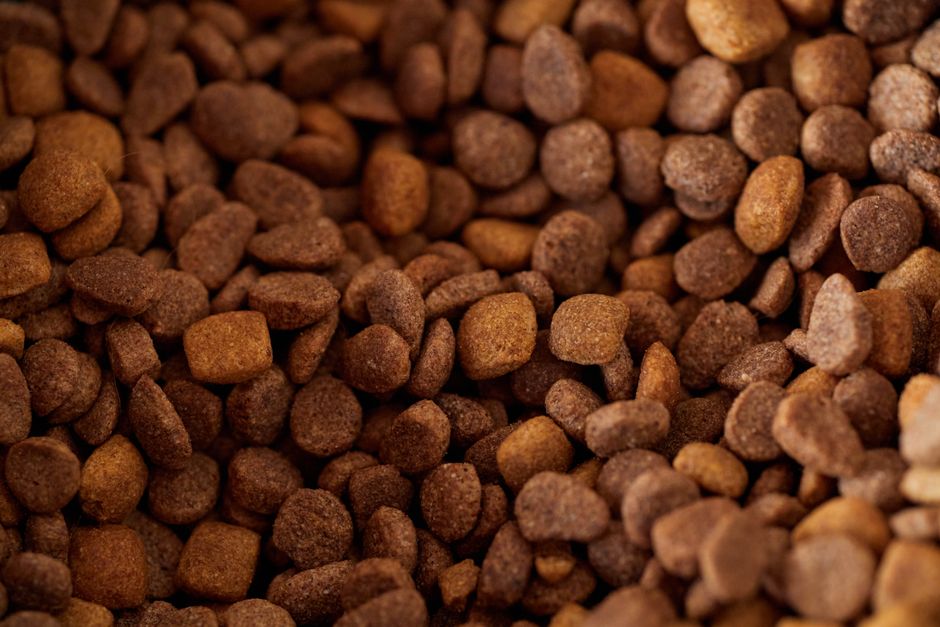
Feed the day’s measured food amount, not an open bowl: begin with the label’s daily guide or a calorie target based on your dog’s ideal body condition, then divide that total into at least two meals. Use the food’s stated calories to convert calories into cups or grams. Recheck body condition and weight, then adjust the total when the plan is not holding a trim shape.
How much food should I feed my dog every day?
Feed the daily amount that supplies your dog’s starting calorie target, then turn that target into a measured amount of the food in the bag. The bag supplies calories per cup, can, tray, or kilogram. The dog supplies the rest of the equation.
The World Small Animal Veterinary Association gives healthy adult dogs in ideal body condition a starting range of 470-590 kcal per day at 10 kg (22 lb) and 790-993 kcal per day at 20 kg (44 lb). Its table uses 130 kcal times body weight in kg to the 0.75 power for active adults and 95 kcal times body weight in kg to the 0.75 power for inactive adults.
Those figures are a starting line. WSAVA says dogs are individuals and some need higher or lower calories to keep an ideal, trim body condition. Ohio State University College of Veterinary Medicine reports that individual needs can differ by as much as 50% from calculated values.
| Step | What to use | What it gives you |
|---|---|---|
| 1 | Your dog’s ideal body condition and target weight, confirmed with a veterinarian where needed | A sound starting point for the calorie estimate |
| 2 | The food label’s calorie statement | Calories in each cup, can, tray, or gram |
| 3 | Daily calorie target divided by calories per unit of food | The measured daily food amount |
| 4 | All treats, table food, medications, and meal food | The full daily intake, not a partial count |
| 5 | Weight and body-condition checks every three to four weeks | Evidence for keeping or changing the plan |
Write the daily amount down before filling the bowl. Then split it. A cup is not a feeding plan. Calories are the common measure across foods with different densities.
Food is one ledger. Treats belong in it. The same discipline of counting snacks as part of a daily food pattern applies here: an extra item still changes the total.
Should I feed my dog once or twice a day?
Feed most dogs at least twice a day, using the same measured daily total rather than doubling the day’s food. VCA Animal Hospitals states that an empty stomach begins sending hunger signals after about 8-10 hours and concludes that at least two meals per day are best for dogs.
One meal suits some adult dogs. It does not suit every dog. Dogs that eat only small volumes or have conditions such as gastroesophageal reflux disease can need more frequent meals, according to VCA Animal Hospitals.
Puppies need a different rhythm. VCA recommends three to four meals a day, dividing the day’s allowance into portions a puppy’s small stomach can hold. Free-choice feeding is not advised for puppies because it can promote juvenile obesity, binge eating, orthopedic problems, and diabetes.
Senior dogs do not follow a single clock. Ohio State notes that older pets often have slower metabolism and lower activity, which can reduce energy needs. Keep the meal timing workable. Change the daily quantity only when the dog’s condition, weight trend, veterinarian, or medical needs call for it.
Do I use my dog's current weight or ideal weight for portions?
Use ideal weight and body condition to set the plan when current weight does not reflect a healthy shape. Current weight tells you what the dog weighs. Body condition tells you whether that weight is being carried well.
The WSAVA Nutrition Assessment Guidelines set the goal for most pets at 4-5 on a 9-point body-condition scale. Disease-risk associations in adult animals appear to rise above 6/9. A dog above that range needs a plan built around restoring condition, not preserving the calories that maintained excess weight.
Body condition outranks the scale alone. VCA notes that it is more useful than the number on the scale when judging whether a young adult dog is underweight, overweight, or ideal. Spayed and neutered dogs have lower energy requirements than intact dogs, while sedentary dogs fed portions based only on body weight are often overfed.
Life stage, activity, illness, medication, treats, table food, feeding method, frequency, and feeding location all belong in the review. WSAVA lists each of them. A fixed scoop cannot see any of them.
“Animals that are not in optimal body condition require frequent monitoring and adjustment of intake in order to achieve and maintain optimal body condition.”
That is the useful loop: choose a starting amount, measure it, watch condition and weight, then change the plan with a veterinarian when the evidence calls for it. Numbers start the work. The dog finishes it.
Are dog food bag feeding charts accurate?
Dog food bag charts are accurate as population-level starting points, not as personal prescriptions. They account for the food’s calorie density and average canine energy requirements, then offer a daily volume across weight ranges.
VCA’s guide to dog food labels says feeding directions are based on averages and should be treated as a suggested starting point. The same guide says a veterinarian can move that amount up or down to meet the calories needed for a healthy body weight.
The chart also cannot know whether the dog is active or inactive, intact or neutered, growing, older, ill, taking medication, eating treats, or carrying extra weight. A label gives a range because the dog in front of you is not an average.
Check the label for a nutritional-adequacy statement that matches the dog’s life stage: growth, reproduction, or adult maintenance. Then check the calories statement. A correct cup measure is still wrong if it is applied to the wrong daily calorie target.
Measured feeding brings the chart back to earth. VCA reports that two or three measured meals provide better intake control than unrestricted food access. The bag begins the calculation. Body condition decides whether it ends there.
Frequently Asked Questions
How do I know if I am overfeeding my dog?
Overfeeding shows up when a dog cannot maintain an ideal body condition or when weight rises on the chosen calorie target. WSAVA sets the usual goal at 4-5 on a 9-point body-condition scale and notes that disease-risk associations rise above 6/9 in adult animals. Check weight and body condition every three to four weeks, then reduce or revise the measured daily amount with veterinary guidance.
Should I free-feed my dog or give scheduled meals?
Scheduled, measured meals give clearer control of intake than unrestricted access to food. WSAVA recommends measured portions whether food is available for grazing or served as meals, and VCA states that dogs unable to hold good body condition with free-choice feeding need measured meal feeding. If food remains out, measure the full daily portion and record what is left.
How often should a puppy eat compared with an adult dog?
Puppies commonly need three to four meals per day because their daily food allowance must fit a small stomach during rapid growth. VCA advises against free-choice feeding for puppies. Healthy adult dogs should receive at least two meals daily, though some adults do well with one meal and some health conditions call for more frequent meals.
Sources
- World Small Animal Veterinary Association: Calorie Needs for Healthy Adult Dogs
- World Small Animal Veterinary Association: Nutrition Assessment Guidelines
- Ohio State University College of Veterinary Medicine: Companion Animal Nutrition Support Service
- VCA Animal Hospitals: Feeding Times and Frequency for Your Dog
- VCA Animal Hospitals: Deciphering Dog Food Labels